
Introduction
Puzzles are among the most beneficial educational toys for children. While they may appear to be simple games, puzzles offer a wide range of developmental benefits that help children build important life skills. From improving problem-solving abilities to enhancing memory and concentration, puzzles turn learning into a fun and engaging experience.
At PIKU TIKU, we believe that every puzzle piece contributes to a child’s growth, creativity, and confidence.
Why Are Puzzles Important for Children?
Puzzles challenge children to think, analyze, and find solutions. Whether it’s a simple shape sorter for toddlers or a complex jigsaw puzzle for older kids, puzzles encourage active learning and help children develop essential cognitive and motor skills.
Unlike passive entertainment, puzzles require children to engage their minds and stay focused on a goal.
Benefits of Puzzles for Children
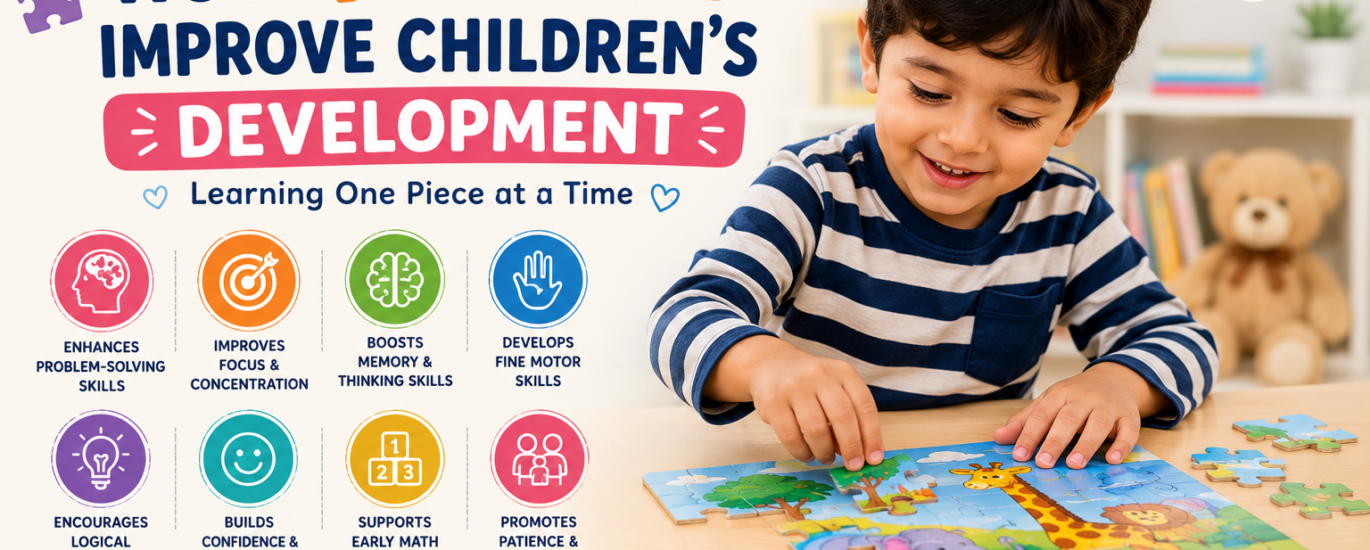
1. Enhances Problem-Solving Skills
Every puzzle presents a challenge that children must solve. They learn to identify patterns, test different solutions, and think critically to complete the task.
These problem-solving skills become valuable throughout school and everyday life.
2. Improves Concentration and Focus
Completing a puzzle requires attention and patience. Children learn to stay focused on a task for longer periods, helping improve their concentration and attention span.
This skill can positively impact academic performance and learning habits.
3. Boosts Memory Skills
Children use memory to remember shapes, colors, images, and patterns while solving puzzles.
Regular puzzle activities help strengthen short-term memory and improve information retention.
4. Develops Fine Motor Skills
Picking up puzzle pieces, rotating them, and fitting them into the correct spaces helps children improve hand-eye coordination and fine motor control.
These skills are important for writing, drawing, and other daily activities.
5. Encourages Logical Thinking
Puzzles teach children how to analyze information and make logical decisions.
They learn concepts such as:
- Matching
- Sequencing
- Categorization
- Spatial awareness
- Cause and effect
These abilities form the foundation of critical thinking.
6. Builds Confidence and Self-Esteem
Completing a puzzle gives children a sense of achievement. Every solved puzzle boosts confidence and motivates them to tackle new challenges.
Success through play helps children develop a positive attitude toward learning.
7. Supports Early Math Skills
Many puzzles involve counting, sorting, recognizing patterns, and identifying shapes.
These activities naturally introduce children to basic mathematical concepts in a fun and stress-free environment.
8. Encourages Patience and Perseverance
Not every puzzle can be solved immediately. Children learn the value of persistence and patience as they work through challenges piece by piece.
These qualities are important for success both inside and outside the classroom.
Types of Puzzles for Different Age Groups
Toddlers (1–3 Years)
- Shape Sorters
- Peg Puzzles
- Large Wooden Puzzles
- Color Matching Games
Preschoolers (3–5 Years)
- Alphabet Puzzles
- Number Puzzles
- Animal Puzzles
- Simple Jigsaw Puzzles
School-Age Children (6+ Years)
- Advanced Jigsaw Puzzles
- Logic Puzzles
- Brain Teasers
- STEM Puzzle Games
- 3D Construction Puzzles
Social Benefits of Puzzle Play
Puzzles are not only educational but also social.
When children solve puzzles with parents, siblings, or friends, they learn:
- Teamwork
- Communication
- Cooperation
- Sharing
- Listening Skills
Puzzle time can become a wonderful bonding activity for the entire family.
How to Encourage Children to Enjoy Puzzles
Parents can make puzzle-solving more enjoyable by:
- Choosing age-appropriate puzzles
- Offering encouragement instead of solutions
- Celebrating progress and achievements
- Participating in puzzle activities together
- Creating a distraction-free environment
The goal is to make learning fun rather than stressful.
Why Parents Choose Puzzles
Parents love puzzles because they provide educational entertainment without excessive screen time.
Puzzles help children:
- Think independently
- Learn through exploration
- Improve focus
- Develop important life skills
- Enjoy meaningful play experiences
Why Buy Puzzles from PIKU TIKU?
At PIKU TIKU, we offer a carefully selected range of puzzles designed to support learning and development at every age.
Our puzzle collection includes:
- Educational Puzzles
- Wooden Puzzles
- Alphabet & Number Puzzles
- Jigsaw Puzzles
- Logic Games
- Brain Teasers
- STEM Learning Puzzles
Each product is chosen to combine fun, learning, and quality.
Conclusion
Puzzles are much more than a simple pastime. They help children develop problem-solving abilities, concentration, memory, patience, creativity, and confidence while making learning enjoyable.
Whether your child is just beginning with shape sorters or tackling advanced brain teasers, puzzles provide valuable opportunities for growth and development.
Explore the exciting world of puzzles at PIKU TIKU and help your child learn, think, and grow—one piece at a time.
PIKU TIKU – Learn, Play & Grow!